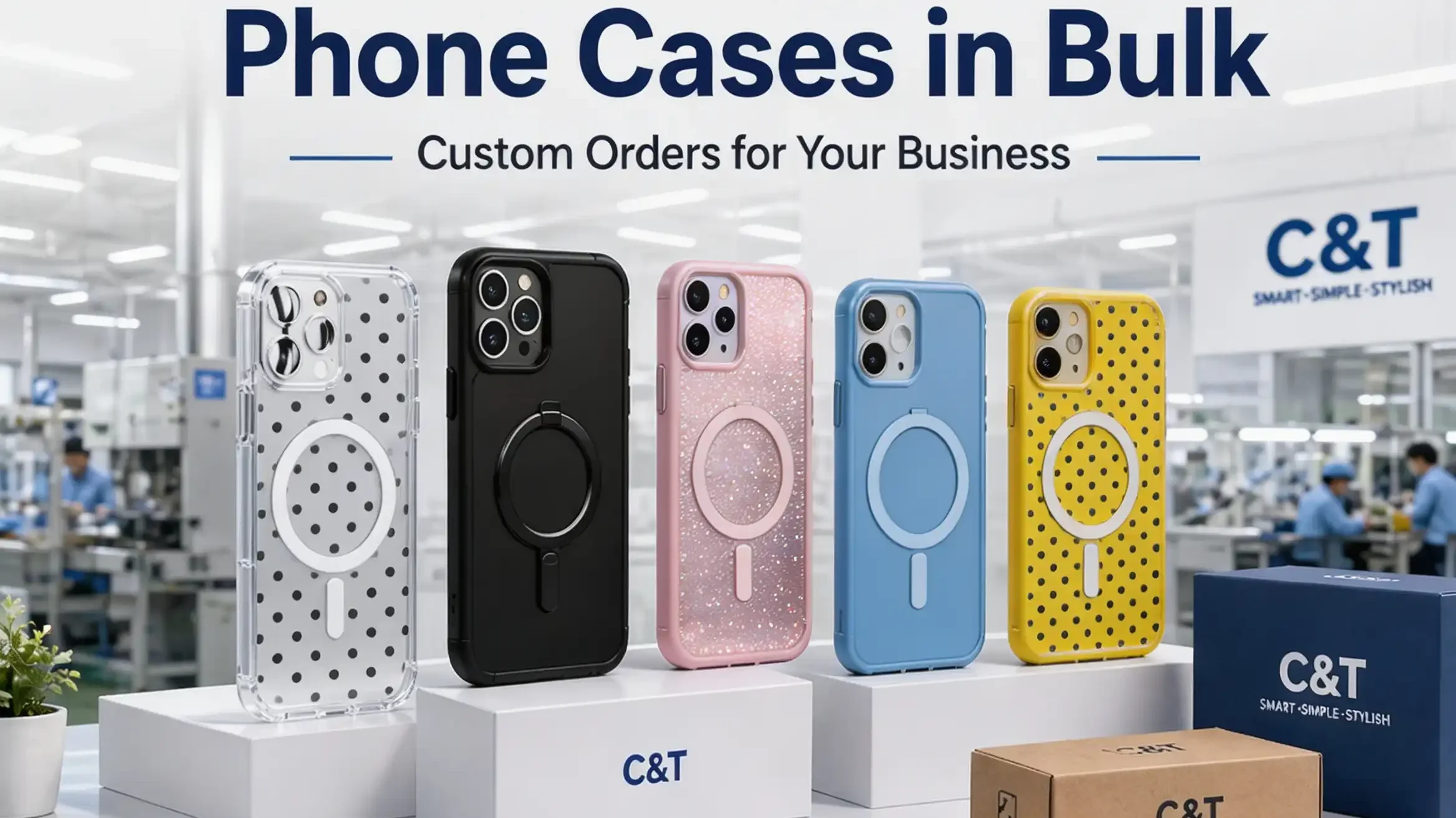
Buying phone cases in bulk in 2026 is no longer just about finding the lowest unit price. For brands, wholesalers, retailers, Amazon sellers, promotional buyers, and mobile accessory distributors, the real challenge is choosing the right material, confirming the right MOQ, avoiding quality problems, and working with a factory that can support repeat production.
C&T is not a retail seller. C&T is a phone case factory supporting custom production, OEM/ODM development, material selection, packaging, and bulk manufacturing for business buyers. From factory-side experience, the buyers who get the best results are not always the ones who ask for the cheapest quote first. They are the buyers who understand their target market, test samples properly, confirm packaging early, and plan production around launch dates.
This guide explains how to buy phone cases in bulk in 2026, including MOQ, materials, customization, quality control, lead times, and EU/US import considerations.
Why Bulk Phone Case Procurement Is Changing in 2026
The phone case market is becoming more specialized. Buyers are shifting from simple plastic shells to products that combine protection, style, sustainability, and accessory compatibility.
From real factory discussions, 2026 demand is strongly connected to MagSafe-compatible and magnetic phone cases, anti-yellowing clear TPU cases, hybrid PC and TPU cases, eco-conscious materials, recyclable packaging, functional cases, and private-label packaging.
C&T’s website positions the brand around one-stop customization, OEM/ODM solutions, sustainable production, reliable manufacturing, and efficient delivery. The website also highlights precision mold capability, multi-material molding, UV printing, pad printing, thermal transfer, electroplating, digital printing, gold foil, silk printing, glitter effects, and IMD. This is important for business buyers because a bulk order is not only a purchasing decision. It is also a product development decision.
What Does “Phone Cases in Bulk” Mean?
Phone cases in bulk means ordering phone cases in larger quantities for resale, brand projects, corporate gifting, retail distribution, promotional campaigns, or customized private-label production.
A bulk order may include standard wholesale models, custom logo printing, unique colors, retail packaging, or full ODM product development. The right buying path depends on your business goal.
If your goal is fast resale, you should choose existing models with stable production and short lead times. If your goal is brand differentiation, you should focus on custom colors, logo placement, packaging design, and surface texture. If your goal is a long-term product line, you should consider mold development, material testing, and private-label planning. If your brand is focused on environmental value, you should evaluate recycled, biodegradable, or lower-impact materials.
For buyers who need design-to-production support, C&T’s OEMODM Phone cases service is the most relevant internal page because it focuses on custom solutions and factory-side development.
2026 Ranking: Best Phone Case Types for Bulk Orders
1. Hybrid Magnetic Cases
Hybrid PC and TPU cases with magnetic rings are one of the strongest choices for premium bulk orders. They combine a rigid back plate, flexible shock-absorbing edges, and wireless charging compatibility.
In the 2026 accessory market, magnetic compatibility matters because buyers increasingly expect phone cases to work with chargers, mounts, wallets, stands, and car accessories. This is especially important for iPhone accessories and premium Android accessory projects.
The Verge reported that Samsung’s mobile R&D leadership said many users already use cases, and magnetic cases are popular. This supports the idea that magnetic functionality is moving into the case ecosystem rather than depending only on the phone body. You can review the report here: The Verge report on magnetic cases.
From a factory perspective, hybrid magnetic cases are best for premium retail, iPhone accessories, Samsung accessories, online stores, and private-label brands. Before mass production, buyers should confirm magnet strength, ring alignment, charging performance, camera-hole tolerance, and finished product weight.
2. Anti-Yellowing Clear Cases
Clear cases remain one of the most reliable categories for phone cases in bulk because they match almost every market. The main issue is yellowing. Buyers should ask about TPU grade, coating, thickness, scratch resistance, and aging tests before confirming an order.
A strong clear case should have good transparency, stable edge thickness, clean button feedback, accurate camera protection, and acceptable anti-yellowing performance. For buyers building a transparent case collection, C&T’s guide to clear phone cases in bulk is a useful internal reference.
3. Kickstand and Multi-Function Cases
Kickstand cases, wallet cases, card-slot cases, and crossbody cases are strong choices when buyers want higher perceived value. These designs are not always the cheapest to produce, but they can support stronger retail margins because they solve practical user needs.
For example, a kickstand phone case is useful for video viewing, office work, travel, online meetings, and entertainment. A wallet case is useful for users who want card storage. A crossbody case is useful for travelers, students, and outdoor users. If your customers care about function more than only price, multi-function cases can outperform basic slim shells.
For this product direction, C&T’s article on wholesale custom phone cases provides a stronger category reference.
4. Sustainable Phone Cases
Sustainability is not just a marketing word. For EU and US buyers, packaging, recycled content, material declarations, and environmental claims can influence supplier evaluation.
C&T’s eco-friendly product direction includes sustainable materials, GRS recycled options, biodegradable options, and greener packaging concepts. For brands building an eco-conscious product line, the internal page for sustainable phone cases should be reviewed before final material selection.
In my opinion, sustainable phone cases work best when the buyer treats sustainability as part of the whole product, not only the case material. The packaging, printing ink, carton usage, product lifetime, and documentation should all support the same positioning.
5. Standard TPU and Silicone Cases
Basic TPU and silicone cases are still useful for price-sensitive markets, promotional projects, and entry-level resale. TPU is flexible, cost-efficient, and widely used in clear cases and soft protective cases. Silicone has a soft-touch feel and can be attractive for lifestyle brands.
The weakness of standard TPU and silicone cases is that they are easy to copy. To avoid selling the same product as everyone else, buyers should use custom colors, better packaging, logo placement, texture, or model selection to create differentiation.
For material insights and production thinking, C&T’s article on best phone case makers gives more useful context.
MOQ: What Quantity Should Buyers Expect?
MOQ depends on material, customization level, color, model coverage, packaging, and whether private mold development is required.
For standard in-stock cases, the MOQ may be more flexible because the structure and production process are already mature. For logo printed cases, the MOQ depends on the printing method, logo size, color, and surface material. For custom color cases, MOQ is usually higher because color matching and material preparation require setup. For private-label packaging, MOQ depends on the box structure, printing method, and packaging supplier requirements. For ODM product development, MOQ is normally higher because design, mold, testing, and production setup all require more factory resources.
My factory-side advice is simple: do not only ask, “What is your MOQ?” A better question is, “What is the MOQ for this material, this color, this logo process, this packaging, and these phone models?” That question helps the factory give a more accurate answer and helps the buyer avoid hidden cost changes later.
Materials: How to Choose Before Ordering in Bulk
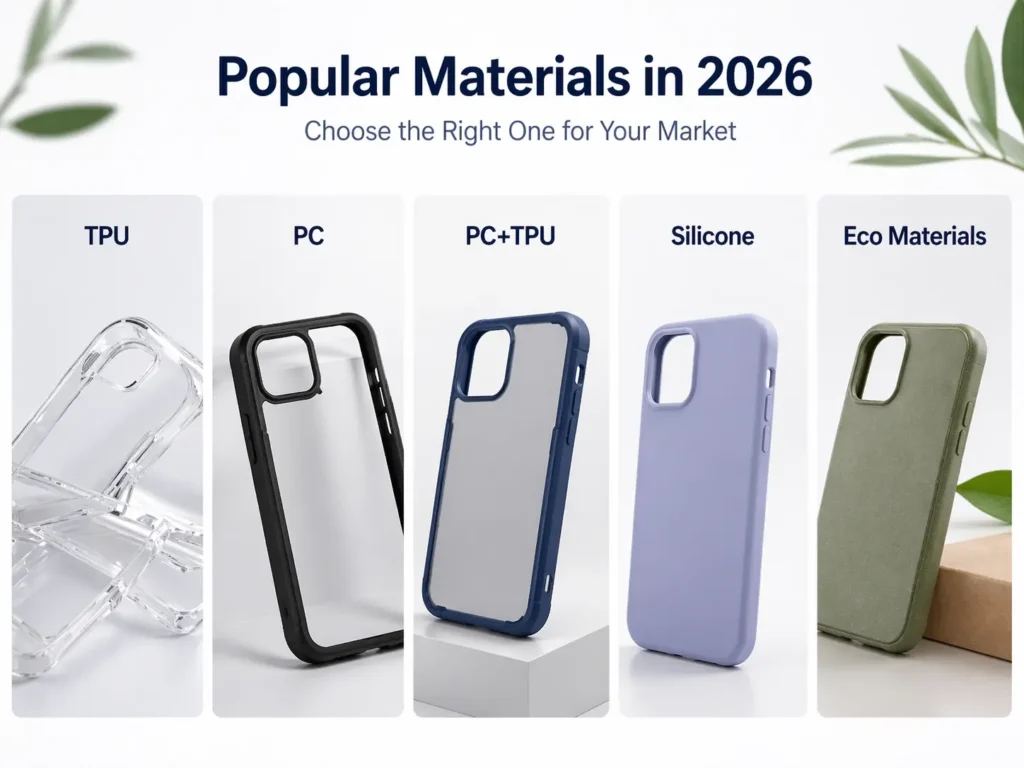
Material choice affects cost, protection, texture, printing result, durability, and customer reviews. A buyer who understands material differences will make better bulk purchasing decisions.
TPU
TPU is flexible, shock-absorbing, and commonly used for clear cases, slim cases, and soft protective shells. It is a good choice for cost-controlled bulk orders. The main risks are yellowing, oil marks, weak transparency, and poor edge finishing.
PC
PC is harder and more rigid than TPU. It is often used as the back plate in hybrid cases. PC is suitable for printed back panels, hard-shell protection, and magnetic cases. The main risk is cracking if the design is too thin or if the structure is poorly engineered.
Hybrid PC and TPU
Hybrid PC and TPU is my top recommendation for premium phone cases in bulk because it balances protection, print quality, comfort, and structure. It works especially well for magnetic phone cases, anti-drop cases, and premium custom cases. Buyers should pay attention to seam quality, mold precision, drop protection structure, and coating stability.
Silicone
Silicone has a soft-touch feel and a premium hand feel. It is suitable for lifestyle brands, fashion collections, and colorful product lines. The main risk is dust attraction, surface wear, and color inconsistency if the supplier does not control material quality properly.
Recycled and Biodegradable Materials
Recycled and biodegradable materials can help a brand stand out, especially in the EU and North American markets. However, buyers should not accept vague claims. They should ask for material information, packaging details, and certification support where relevant.
Customization Options for Bulk Phone Case Orders
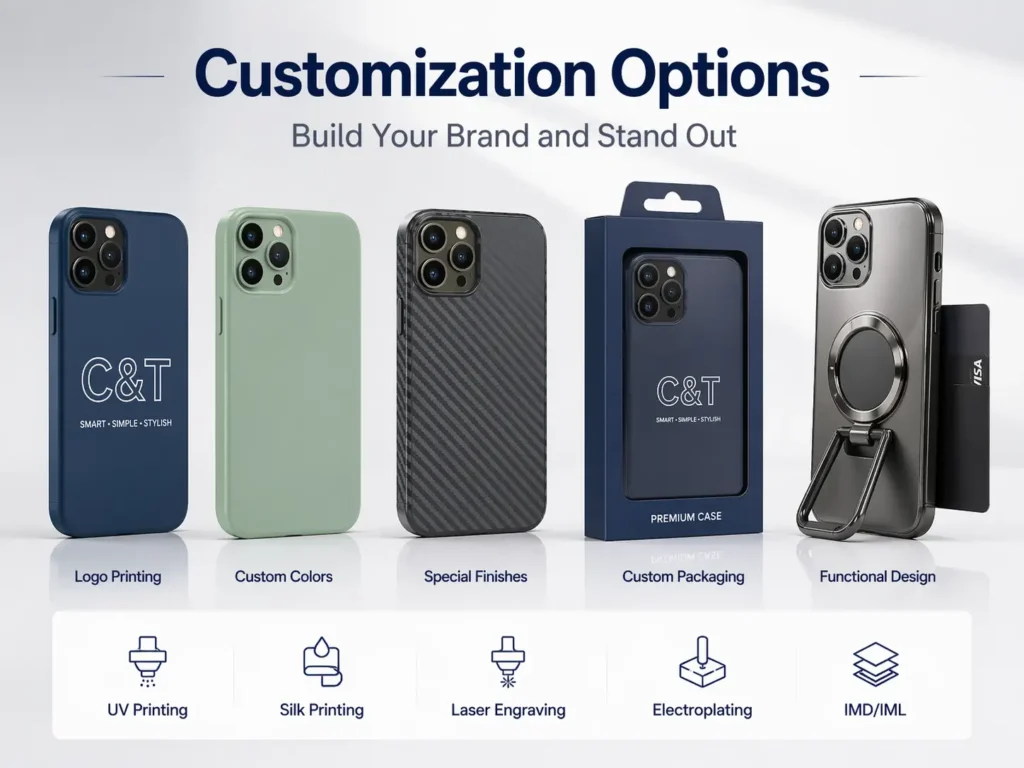
Customization is one of the biggest reasons buyers choose a factory instead of a simple reseller. C&T supports factory processes such as precision molds, multi-material molding, UV printing, pad printing, thermal transfer, digital printing, electroplating, gold foil, silk printing, glitter effects, and IMD.
Logo printing is suitable for brand owners, corporate gifts, event campaigns, and retail products. The best printing method depends on the material and surface. Custom colors help brands build seasonal collections, but buyers should always approve color samples under natural light and indoor light. Private-label packaging can increase perceived value, especially for online brands and retail stores. Model coverage is also important because a successful bulk order often includes several popular iPhone and Samsung models rather than only one model.
If your buyer journey is still at the product exploration stage, C&T’s phone case wholesale page is a useful place to review product directions.
Factory Production and Lead Times
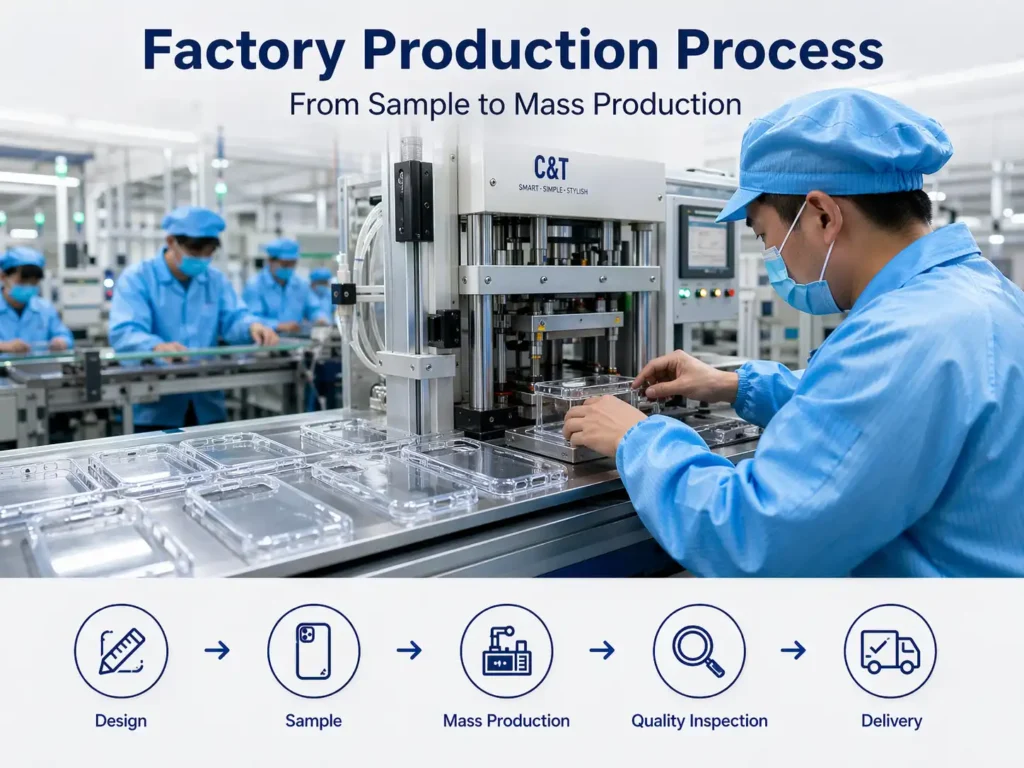
AI Mode correctly focused on pre-production, mass production, logistics, and quality control. For a real factory order, I recommend dividing the process into six stages.
The first stage is RFQ and requirement confirmation. Buyers should send the model list, quantity, material, color, logo file, packaging request, target market, and expected delivery date.
The second stage is sample development. Samples are essential for custom orders because photos alone cannot prove fit, hand feel, button response, or packaging quality.
The third stage is fit and function testing. Buyers should test camera holes, buttons, charging port, speaker holes, wireless charging, magnetic alignment, card slot, kickstand, and drop protection structure.
The fourth stage is packaging approval. Buyers should confirm box size, barcode, SKU label, language, warning labels, and carton packing method before mass production.
The fifth stage is mass production. This usually includes molding, material preparation, printing, assembly, inspection, and packing.
The sixth stage is pre-shipment inspection. Buyers should check appearance, color, logo position, packaging, quantity, carton marks, and random fit testing before shipment.
For buyers comparing supplier types, working directly with a phone case supplier that has factory-side development ability can reduce communication gaps and improve production control.
EU and US Import Considerations for Phone Cases
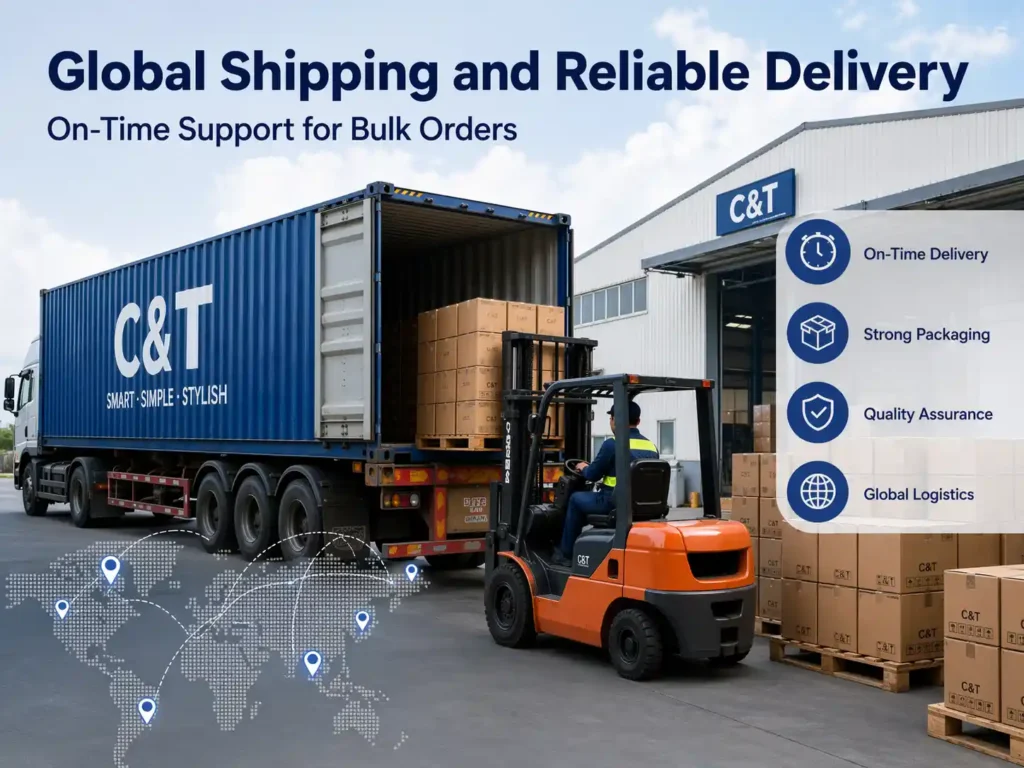
For EU and US buyers, import planning should start before production, not after goods are packed.
The US International Trade Commission explains that the Harmonized Tariff Schedule provides tariff rates and statistical categories for merchandise imported into the United States. Buyers should confirm the correct HTS classification with their customs broker before shipment. You can check the official source here: USITC Harmonized Tariff Schedule.
For the EU, the RoHS Directive restricts hazardous substances in electrical and electronic equipment to protect human health and the environment. A simple phone case without electronics may not always be treated the same way as an electronic accessory, but magnetic parts, bundled accessories, packaging claims, or special materials can create additional compliance questions. Buyers should confirm requirements with an importer, lab, or compliance consultant for the exact product. You can review the official EU information here: European Commission RoHS Directive.
For responsible sourcing, the OECD Due Diligence Guidance encourages businesses to understand and implement responsible business conduct in supply chains. This supports asking suppliers about materials, workplace practices, traceability, and documentation. The official guidance is available here: OECD Due Diligence Guidance.
In practical terms, EU and US buyers should confirm HS or HTS codes with a customs broker, ask for material declarations when needed, check whether RoHS, REACH, or CPSIA may apply, avoid unsupported eco claims, confirm carton labels and packaging language, and make sure invoices, packing lists, and product specifications are consistent.
For broader supplier comparison, C&T has also written about choosing a wholesaler of mobile accessories for EU and US buyers.
Factory vs Wholesaler: Which Is Better for Bulk Orders?
If you are buying phone cases in bulk, you usually have three supplier options: marketplace sellers, trading companies, and factories.
A marketplace seller is convenient for small tests and fast purchases, but customization is limited and quality can be unstable. A trading company can help buyers source mixed accessories, but it may not directly control mold development, material selection, or production schedule. A phone case factory is better for custom orders, repeat production, private label, packaging, and product development, but buyers need to provide clearer specifications before quoting.
For long-term B2B growth, factory cooperation is usually stronger because it helps buyers build a stable product line, improve design details, and reduce repeated sourcing work. If you are comparing manufacturers, C&T’s guide to wholesale cases for phones can help you evaluate supplier types.
Cost Factors: Why Unit Price Changes So Much
Many buyers ask for one price immediately, but the unit price of phone cases in bulk depends on several variables.
Material is one of the biggest cost factors. TPU is usually more cost-efficient than complex hybrid structures or eco materials. Structure also matters because a simple slim case costs less than a magnetic kickstand case or a wallet case. Printing can change cost significantly because one-color logo printing is simpler than full-wrap UV printing, IMD, thermal transfer, or raised texture printing. Packaging also affects the final price because a plain polybag is much cheaper than a retail box, drawer box, kraft box, or custom insert.
Quantity can reduce unit cost, but only when the design, color, and model plan are stable. Inspection standard is another factor. More strict inspection may increase cost, but it can reduce return risk and protect your customer reviews.
My advice is to calculate landed cost, not only factory price. A cheaper case with weak packaging, poor fit, or high defect rate can cost more after returns, complaints, and replacement shipments.
Quality Control Checklist Before Mass Production
Before confirming a bulk order, buyers should check the real device fit, button response, camera-hole accuracy, charging port position, speaker-hole alignment, wireless charging performance, magnetic ring position, logo placement, color consistency, clear case transparency, packaging strength, carton labels, SKU labels, edge finishing, and surface cleanliness.
A reliable supplier should be able to answer these quality questions clearly. If a supplier avoids these details and only repeats a low price, the buyer should be careful.
How to Prepare an RFQ for Phone Cases in Bulk
A strong RFQ saves time and helps the factory give a better quote. The buyer should include phone models, quantity per model, case type, material preference, logo file, color requirements, packaging style, target market, compliance requirements, expected delivery date, shipping destination, and sample request.
The more specific the RFQ is, the more accurate the quotation will be. A vague request such as “Send me your best price for phone cases” usually creates slow communication and inaccurate pricing. A clear RFQ allows the factory to recommend the right material, printing method, packaging solution, and production schedule.
Why Work with C&T for Phone Cases in Bulk?
C&T is suitable for buyers who need factory production rather than retail purchasing. The brand focuses on OEM/ODM customization, precision mold capability, multi-material phone case production, sustainable material options, custom packaging support, sample confirmation, and repeat production.
What makes C&T different is its factory-side ability to move from idea to sample and from sample to mass production. This is valuable for brands, wholesalers, distributors, importers, and retailers that need more than a standard product list.
For buyers who want phone cases in bulk, C&T can support product development, material guidance, logo customization, packaging planning, quality control, and production communication. This helps buyers reduce sourcing risk and build a more stable phone case business.
Final Advice
Buying phone cases in bulk in 2026 should be treated as a product strategy, not just a purchasing task. The best results come from matching the right case type, material, MOQ, packaging, quality standard, and import plan before production starts.
If you are building a long-term phone case business, choose a factory that can support samples, customization, material guidance, packaging, and repeat production. That is where C&T can create value for brands, retailers, wholesalers, distributors, and importers looking for stable bulk phone case manufacturing.
FAQ About Phone Cases in Bulk
What is the best material for phone cases in bulk?
For most buyers, hybrid PC and TPU is the best balance of protection, appearance, and customization. TPU is better for cost-efficient clear cases, while silicone is better for soft-touch lifestyle products.
What is the normal MOQ for bulk phone case orders?
MOQ depends on design, material, color, printing, packaging, and model coverage. Standard designs usually allow more flexible MOQ, while custom colors, private packaging, and ODM projects usually require higher quantities.
Can I order custom phone cases in bulk with my logo?
Yes. Logo customization can be done through UV printing, silk printing, pad printing, IMD, thermal transfer, digital printing, or other surface processes depending on the material and design.
How long does production take?
Production time depends on order quantity, customization level, packaging, and sample approval speed. Standard orders can be faster, while ODM projects, custom packaging, and multi-model production need more planning time.
Are sustainable phone cases good for bulk orders?
Yes, especially for EU retailers, eco-focused brands, corporate gifting, and premium packaging projects. Buyers should request material information and avoid unsupported sustainability claims.
Should I buy from a factory or a wholesaler?
For standard resale, a wholesaler can be convenient. For custom colors, private label, repeat orders, packaging, and ODM development, a factory is usually the better choice.