
Why do clear phone cases turn yellow? Is TPU or PC better for maintaining transparency? And how can brands verify whether an anti-yellowing phone case actually performs as claimed?
For phone case brands, wholesalers and retailers, transparency is more than an aesthetic feature. It is a product quality consideration that can directly affect customer satisfaction, product reviews and repeat purchases.
A clear phone case needs to maintain its appearance while providing everyday protection. However, not all transparent materials age in the same way. Polymer chemistry, UV exposure, heat, material formulation and product construction can all influence long-term appearance.
For buyers sourcing custom clear phone cases, understanding these differences is essential before selecting a material or approving a new product.
In this guide, we answer seven important sourcing questions and explain how C&T approaches anti-yellowing phone case development.
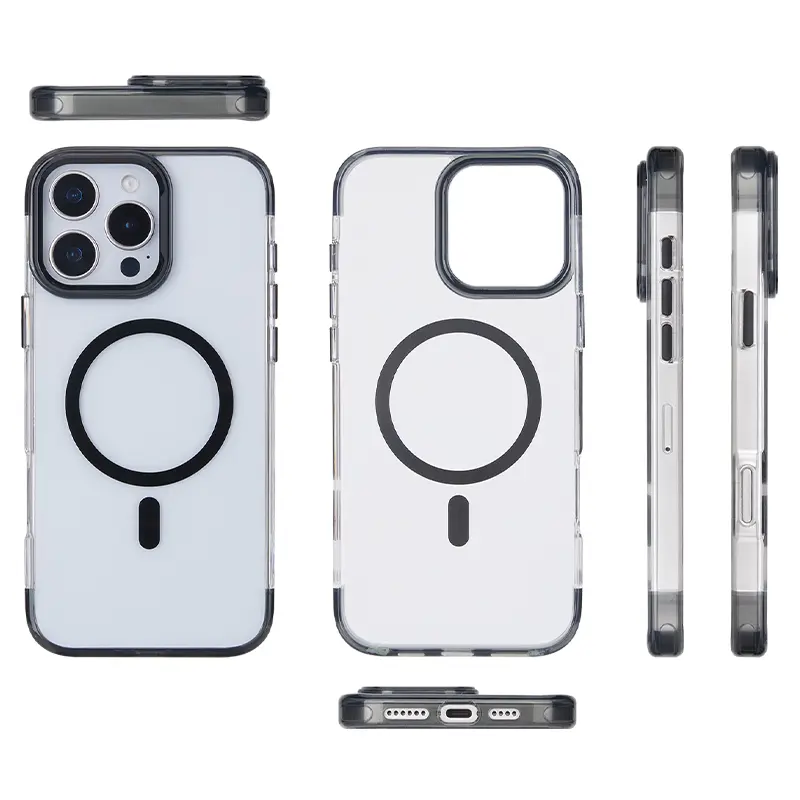
Q1. Why Do Clear Phone Cases Turn Yellow?
Direct answer: Clear phone cases can turn yellow because of chemical aging within the plastic, particularly when certain polymer formulations are exposed to ultraviolet (UV) light, heat and oxygen over time.
This process is commonly associated with photo-oxidation.
When susceptible polymers are exposed to UV radiation, chemical changes can occur within their molecular structure. These changes may create compounds that absorb visible light differently, making the material appear yellow or amber.
Several factors can influence the process:
1. UV Exposure
Sunlight and other UV sources can accelerate the degradation of susceptible polymer materials.
2. Heat
Higher temperatures can accelerate material aging and affect the stability of some additives and polymer formulations.
3. Material Chemistry
Different polymer families and formulations have different levels of resistance to UV-related discoloration.
4. Surface Contamination
Sweat, skin oils, cosmetics and environmental dirt can accumulate on a phone case. These may create visible staining or discoloration, although surface contamination is not the same as permanent chemical yellowing.
It is important to distinguish between the two.
Surface dirt may be removable through appropriate cleaning. However, once the polymer itself has chemically discolored, cleaning cannot reliably restore its original transparency.
For brands, this means that preventing yellowing starts with material selection and product engineering, not simply with consumer cleaning instructions.
Q2. Does Every TPU Clear Phone Case Turn Yellow?
Direct answer: No. TPU is not a single uniform material. Its resistance to yellowing depends on its chemical structure, raw material grade, additives and formulation.
TPU stands for Thermoplastic Polyurethane. It is widely used in clear phone cases because it offers flexibility, impact absorption and convenient installation.
However, different TPU chemistries can have significantly different optical properties.
One important distinction is between aromatic and aliphatic TPU.
Aromatic TPU
Aromatic TPU can experience UV-related yellowing.
According to Covestro’s technical explanation, UV exposure can cause yellowing in aromatic TPU through chemical changes within its polymer structure.
UV stabilizers can slow this process, but they do not necessarily eliminate it.
Aliphatic TPU
Aliphatic TPU grades generally offer better resistance to UV-induced yellowing.
Covestro explains that aliphatic TPU materials were developed to address this optical limitation.
This distinction is important when evaluating a transparent TPU phone case.
A supplier simply stating “TPU material” does not provide enough information to evaluate anti-yellowing performance.
What should buyers ask?
- Is the TPU aromatic or aliphatic?
- What is the specific material grade?
- Does the formulation include UV stabilizers?
- Is there a material or finished-product aging test report?
- How is transparency evaluated after exposure?
Technical reference: Covestro — Optical Properties of TPU
Q3. Is PC Better Than TPU for Anti-Yellowing Clear Phone Cases?
Direct answer: PC and TPU offer different performance characteristics. PC can be a useful material for transparent rigid back panels, while TPU provides flexibility and shock absorption. However, PC is not automatically immune to yellowing.
PC stands for Polycarbonate.
It is commonly used in phone case construction because of its rigidity, dimensional stability and optical properties.
TPU, by comparison, is more flexible and suitable for protective edges and shock-absorbing structures.
However, PC can also undergo UV-related discoloration.
According to ADEKA’s polymer additives technical FAQ, polycarbonate can undergo photochemical reactions under UV exposure that result in yellowing.
Therefore, selecting PC instead of TPU does not automatically guarantee long-term clarity.
Material grade, UV stabilization, processing and finished-product testing remain important.
TPU vs PC: Which Should Brands Choose?
| Consideration | TPU | PC |
|---|---|---|
| Material character | Flexible | Rigid |
| Main application | Edges and flexible structures | Back panels and rigid structures |
| Shock absorption | Good flexibility and impact absorption | Depends on construction |
| Optical performance | Depends on TPU chemistry and formulation | Depends on PC grade and processing |
| Yellowing resistance | Varies by formulation | Also requires UV resistance evaluation |
| Typical product role | Flexible protective bumper | Transparent structural back |
For many brands, the decision is not necessarily TPU versus PC.
It is whether a combination of both materials can deliver the right balance of transparency, protection, handling and product positioning.
Technical reference: ADEKA — Polymer Additives and Light-Induced Discoloration
Q4. What Is the Best Construction for an Anti-Yellowing Clear Phone Case?
Direct answer: The right construction depends on the target performance, product design and material requirements. Hybrid PC and TPU structures can combine a rigid transparent back with flexible protective edges, but every material component should be evaluated separately.
Brands can consider three main development directions.
01. Full TPU Clear Phone Case
A flexible transparent case designed for everyday handling and protection.
Potential advantages:
- Flexible installation and removal
- Shock-absorbing structure
- Slim product design
- Customizable surface treatments
For this type of product, buyers should pay particular attention to TPU chemistry, material grade and yellowing resistance.
02. PC + TPU Hybrid Clear Phone Case
A hybrid construction combines a rigid PC back panel with flexible TPU edges.
Potential advantages:
- Rigid transparent back panel
- Flexible protective edges
- Different material properties across product zones
- Opportunities for magnetic functions and decorative details
However, hybrid construction alone does not guarantee anti-yellowing performance. The PC back, TPU edges and other exposed components should all be evaluated.
03. Enhanced Surface and Material Solutions
Depending on the design, brands may consider:
- UV-stabilized material formulations
- Anti-yellowing material grades
- Scratch-resistant surface treatments
- Improved material selection for high-contact areas
- Different material combinations for structural components
The purpose is to develop a product where appearance, functionality and durability work together.
Q5. How Can Brands Test the Anti-Yellowing Performance of a Clear Phone Case?
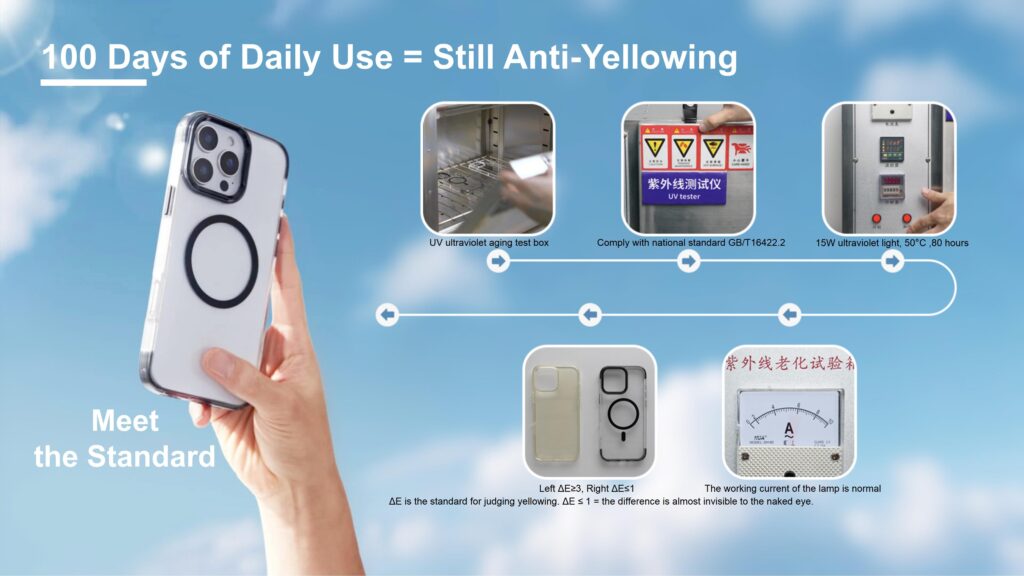
Direct answer: Brands should request documented accelerated-aging tests, compare the material’s appearance before and after exposure, and review objective color measurements rather than relying only on an anti-yellowing label.
This is one of the most important steps when sourcing wholesale clear phone cases.
A product may look perfectly transparent when new, but that alone does not demonstrate its long-term color stability.
What Testing Methods Can Be Used?
Different standards serve different purposes.
ISO 4892-3 — Fluorescent UV Exposure
This standard describes methods for exposing plastic materials to fluorescent UV radiation under controlled heat and moisture conditions.
In practice, the test helps evaluate how plastics respond to simulated weathering and UV exposure over time.
[ISO 4892-3]
ISO 4582 — Colour Change After Exposure
For evaluating colour stability, ISO 4582:2025 specifies methods for measuring changes in colour and other properties of plastics after natural weathering or laboratory radiation exposure.
These measurements help buyers understand how much a material’s appearance has changed following exposure.
[ISO 4582:2025]
ASTM E313 — Yellowness Index
Unlike exposure standards, ASTM E313 focuses on measuring colour appearance. It provides a method for calculating yellowness and whiteness indices from instrumentally measured colour coordinates.
As a result, buyers can use the Yellowness Index (YI) to quantify yellowing rather than relying solely on visual judgment.
[ASTM E313]
How Do These Testing Methods Work Together?
These methods serve complementary purposes. While ISO 4892-3 evaluates material response to fluorescent UV exposure, ISO 4582 helps determine changes in colour and other properties.
Meanwhile, ASTM E313 provides a quantitative way to assess yellowness and whiteness.
For brands sourcing clear phone cases, combining appropriate exposure testing with objective colour measurements provides a more reliable basis for comparing material performance.
What Should a Test Report Include?
When reviewing an anti-yellowing phone case, buyers should request:
| Test information | What to check |
|---|---|
| Material | Exact material grade and formulation |
| Test method | Applicable standard and version |
| Light source | UV or xenon-arc exposure |
| Test conditions | Temperature, irradiance and humidity |
| Exposure duration | Total testing time |
| Initial appearance | Original colour and transparency |
| Final appearance | Colour change and visible discoloration |
| Measurement | Yellowness Index (YI) or colour difference (ΔE) |
| Product condition | Cracking, surface changes and mechanical performance |
A useful report should also identify the specimen thickness, preparation method and whether the test was conducted on raw material or the finished phone case.
One important point: Accelerated-aging results should not automatically be converted into an equivalent number of days or years of real-world use. Such a relationship requires a validated correlation.
For brands, the objective is to compare materials and products under defined, repeatable conditions.
Q6. What Should Buyers Ask a Clear Phone Case Manufacturer Before Placing an Order?
Direct answer: Buyers should confirm the material grade, construction, anti-yellowing evidence, sample performance and customization options before approving a wholesale order.
A professional sourcing discussion should go beyond asking whether a product is “anti-yellowing”.
Here are six questions worth including in your supplier evaluation:
1. What Is the Exact Material Grade?
Ask whether the clear case uses TPU, PC, a hybrid structure or another transparent material.
2. What Is the Anti-Yellowing Approach?
Understand whether the product relies on material selection, UV stabilizers, surface treatments or structural design.
3. Can You Provide Test Documentation?
Request the relevant test report and clarify the test method, exposure conditions and results.
4. Can We Evaluate a Physical Sample?
Review transparency, surface quality, flexibility, fit, buttons and camera openings.
5. Can the Product Be Customized?
Confirm available colors, materials, printing, branding, magnetic functions and packaging.
6. What Are the MOQ and Development Lead Time?
Confirm quantities by model and color, sample requirements and the production schedule.
These questions help brands compare suppliers based on actual product performance rather than marketing descriptions alone.
Q7. What Anti-Yellowing Clear Phone Case Solutions Does C&T Offer?
Direct answer: C&T offers both transparent TPU and PC/TPU hybrid phone case development options, supporting brands with different material, structural and functional requirements.
Our existing product range demonstrates two distinct approaches.
Option 01. TPU Clear Phone Case
C&T’s current TPU Clear Phone Case product page lists:
- Anti-yellowing acrylic TPU
- 1H hardness protection
- 2.0mm Slim Armor construction
- Precision-fit cutouts
- MOQ: 300 pcs
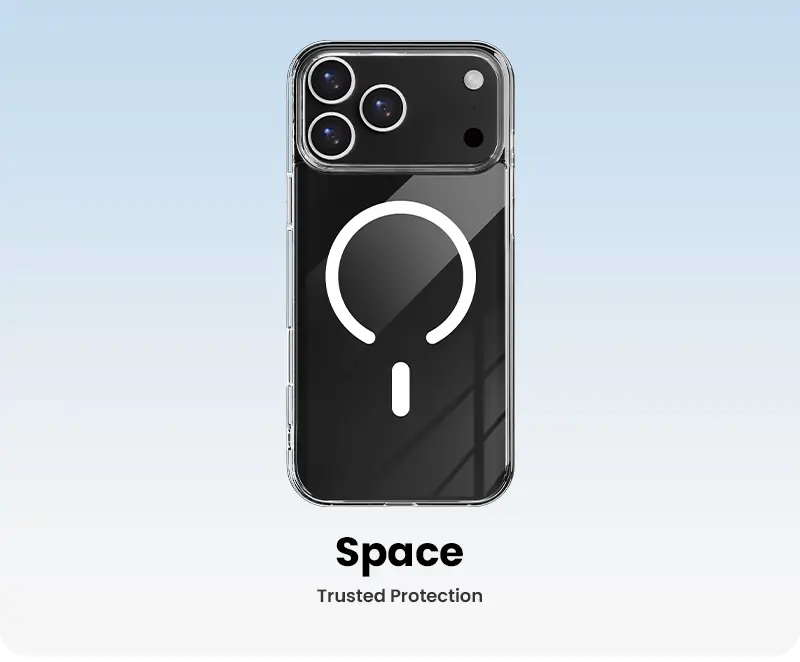
Explore the C&T TPU Clear Phone Case.
Option 02. Anti-Yellowing Magnetic PC + TPU Phone Case
For brands looking for a hybrid construction, C&T also offers an anti-yellowing magnetic phone case featuring:
- Clear Bayer PC back panel
- Soft TPU edges
- Metal buttons
- Hybrid structural design
- Magnetic functionality
- MOQ: 300 pcs
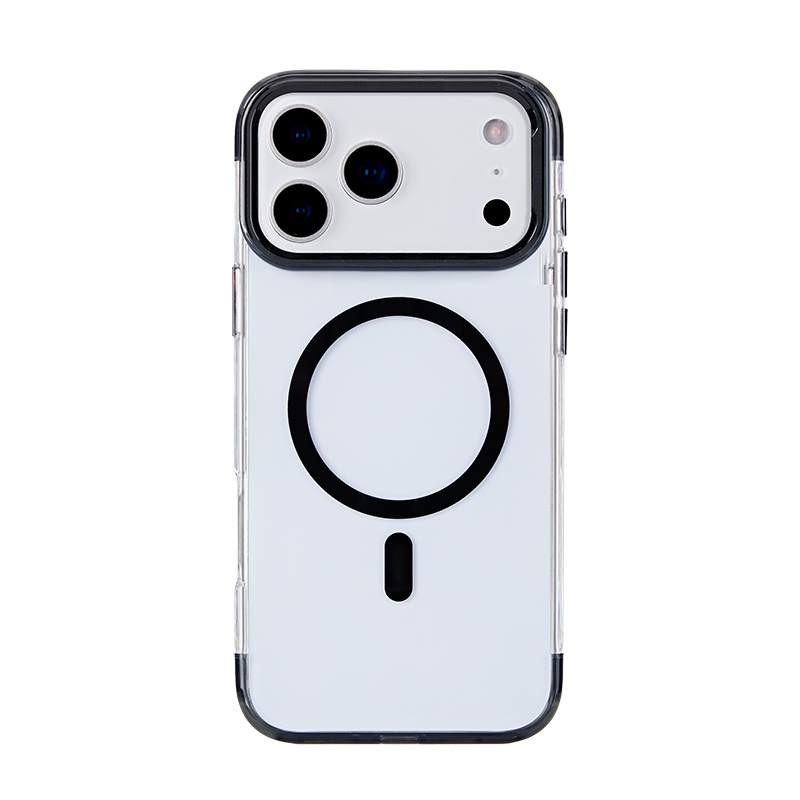
Explore the C&T Anti-Yellowing Magnetic Phone Case.
How Does C&T Approach Anti-Yellowing Product Design?
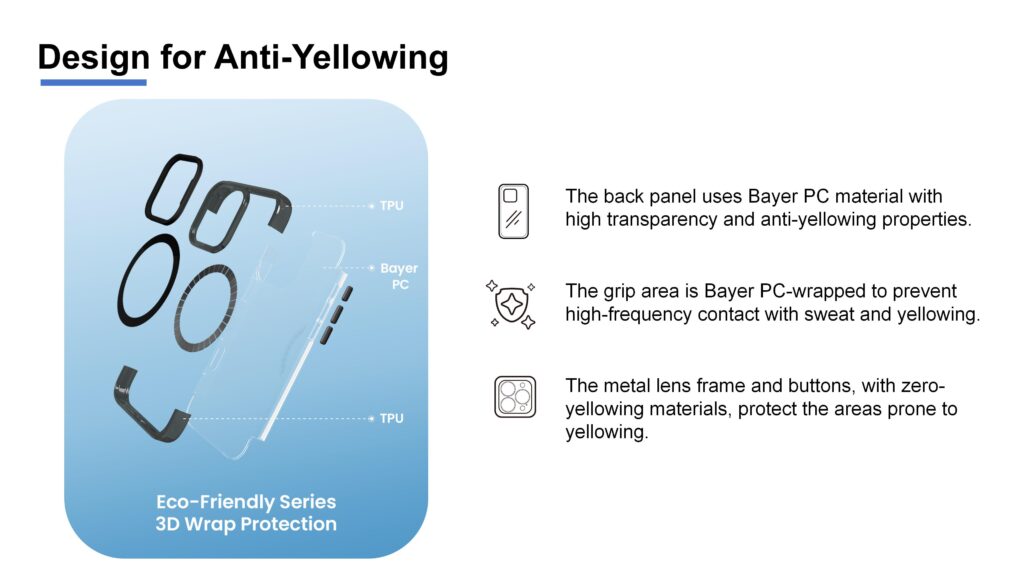
C&T’s Apex design concept demonstrates how material selection can be applied to different parts of a phone case.
The concept includes:
- Bayer PC back panel for transparency and anti-yellowing performance
- PC-wrapped grip area to address frequent hand contact
- TPU components for flexible protection
- Metal camera frame and buttons for exposed detailing
For brands, this provides a starting point for discussing different product structures, materials and customization requirements.
Q8. How Can Brands Develop Custom Anti-Yellowing Clear Phone Cases with C&T?
Direct answer: Start by sharing your target device model, preferred case construction, material requirements, estimated quantity and testing expectations. C&T can then discuss suitable product options and development requirements.
To help us understand your project, prepare the following information:
| Project information | Your requirements |
|---|---|
| Device model | iPhone, Samsung or other models |
| Product type | Full TPU, PC or PC/TPU hybrid |
| Appearance | Crystal clear, transparent or tinted |
| Functions | Magnetic compatibility, drop protection or other features |
| Branding | Logo, printing and custom detailing |
| Quantity | Estimated order volume |
| Testing | Required anti-yellowing standards or reports |
| Market | USA, Europe or other target markets |
C&T supports custom phone case development from material selection and structural design to sampling, manufacturing and packaging.
Explore our OEM/ODM phone case development services or browse our complete Phone Case Product Range.
Looking for a Reliable Clear Phone Case Manufacturing Partner?
Whether you are developing a new transparent phone case collection, sourcing anti-yellowing materials or looking for a custom PC/TPU hybrid design, C&T can help you evaluate the right product direction.
Tell us your target model, preferred material and estimated quantity.
Contact C&T to Discuss Your Custom Clear Phone Case Project
C&T — Retail-Ready Mobile & Lifestyle Accessory Solutions.
Let’s develop a clearer, better-performing phone case collection together.